
The Battery Operated Shoulder Sprayer works on the principle of pressurized liquid delivery. Instead of using manual pumping to build pressure, a small DC motor and pump assembly, powered by a battery, creates the required pressure inside the liquid chamber or pump line. This pressure forces the spray liquid (pesticide solution, herbicide solution, or fertilizer mixture) through the delivery pipe and nozzle. The liquid is atomized to fine droplets by nozzle. These droplets are then distributed onto the crop surface.
The efficiency of the Battery Operated Shoulder Sprayer depends on:
- Pressure generated by the pump,
- Flow rate,
- Type and design of the nozzle,
- Battery backup and capacity,
- Uniformity of spray droplet size.
Major Parts of a Battery Operated Shoulder Sprayer
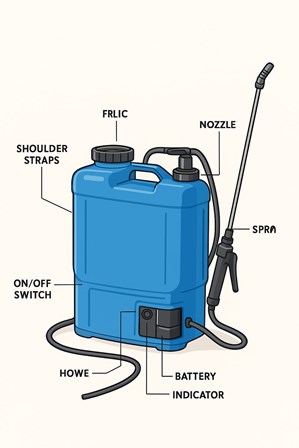
Typically these types of sprayers consists of the following major components:
1. Tank (Chemical Container)
The tank is made of from high-density polyethylene (HDPE) or other non-corrosive, chemical-resistant plastics. It would have a wide mouth and lid for easy refilling and washing, a strainer and markings on side for quantity of liquid in the tank. Tanks are available from 12 to 20 liters model wise.
2. Battery
A 12 volt, 8-12 Ah, sealed lead acid or lithium-ion rechargeable battery is used. A charging port and indicating light are also provided.
3. Electric Motor
A small lightweight, low noise, and durable dc motor, running on 12 volt runs the pump assembly.
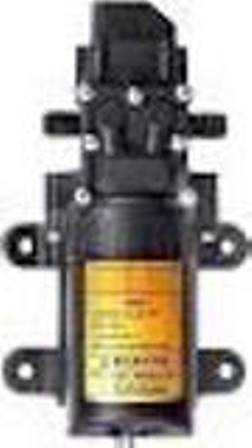
4. Pump Assembly
Generates the pressure required to push the liquid through the spraying system. Two types of pump are used: a) diaphragm and b) piston pump. The diaphragm type is more common. The pump pressure is around 30 – 60 psi.
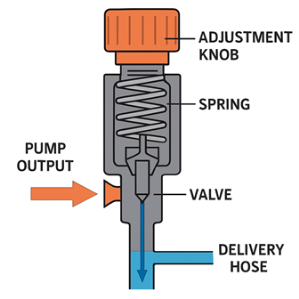
5. Pressure Regulator or Control Valve
Maintains a constant spraying pressure and allows the operator to adjust flow rate. It also prevents over-pressurization and ensures uniform spray droplet size.
The regulator consists of a spring-loaded valve inside a small chamber. When the pump pressure rises above the preset level (say 2.5–3 bar), the excess pressure pushes against the spring. This opens the valve slightly and allows some of the liquid to bypass—usually returning to the tank. When pressure drops, the spring pushes the valve closed again, so more liquid flows toward the delivery hose.
6. Delivery Hose Reinforced PVC or rubber Flexible tube that carries pressurized liquid from the pump to the spray lance or gun. Resistant to chemicals and abrasion.
7. Spray Gun / Lance made of plastic or stainless steel with trigger or lever mechanism.
8. Nozzle There are different types of nozzles e.g. hollow cone (for fungicides and insecticides), Flat fan nozzle (for herbicides), and Adjustable nozzle (multi-purpose, can vary droplet size and pattern).
9. Switch & Control Panel
10. Frame & Shoulder Straps
11. Charger
Applications beyond Agriculture
While mainly used in agriculture, Battery Operated Shoulder Sprayers are also used in:
- Horticulture and floriculture.
- Greenhouses and nurseries.
- Disinfecting public spaces (especially post-COVID).
- Pest control in warehouses and households.
Advantages of Battery Operated Shoulder Sprayers
- Reduced Labor: No manual pumping required, less operator fatigue.
- Efficiency: Constant pressure ensures uniform droplet size and better chemical utilization.
- Portability: Can be carried easily on shoulders and used in different terrains.
- Time Saving: Sprays larger areas in shorter time compared to manual shoulder Sprayers.
- Versatility: Can be used for insecticides, herbicides, fungicides, liquid fertilizers, and even sanitizers in non-farm applications.
Maintenance of a Battery Operated Shoulder Sprayer
To ensure long life and reliable performance:
- Clean tank and nozzles after every use.
- Do not leave chemicals in the tank overnight.
- Periodically check hose and connections for leaks.
- Store battery in charged condition to prevent deep discharge damage.
- Lubricate moving parts if recommended by manufacturer.
- Replace nozzles if they show wear or clogging.
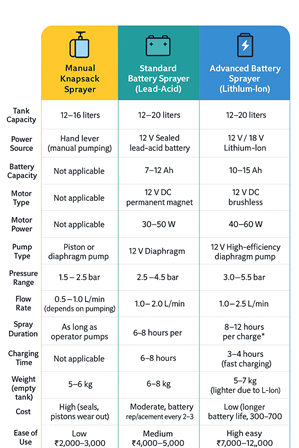
Understand with an info graphics
Conclusion
A Battery Operated Shoulder Sprayer is a modern tool that combines portability, efficiency, and ease of use. By replacing manual pumping with a battery-powered motor and pump, it saves labor and provides consistent spraying pressure. The main parts—tank, battery, motor, pump, hose, spray gun, and nozzle—work together to deliver a fine spray of chemicals that ensures better pest and weed management. Proper operation and maintenance make it a highly valuable device for farmers, gardeners, and even sanitation workers. Non shoulder sprayers with similar designs are also used for spraying.

Hi ; I have had opportunity to travel widely and have keen watched whatever farming practices the local farmers were engaged in. Back home been growing gerberas mostly in polyhouses, but outside in kitchen garden as well. i love these hardy perennials. good for business too if done in a routine orderly scientific manner. Also engaged in farming of wheat and organic vegetables on a small scale for me and family. My service profile has been that of an electronic and telecom engineer and now am engaged in web site creation and blogging.
Leave a Reply